
For fans of history and culture, the Morrin Centre should be at the top of your Quebec City itinerary. We spent three days in Quebec City and the Morrin Centre was a highlight. This National Historic Site was home to several important Quebec City institutions over the past 200 years.
The Morrin Centre is an ideal activity for a rainy day in Quebec City. I encourage you to visit regardless of the weather. We headed over to this museum and cultural centre because it was raining outside, and I'm grateful that it did rain now. Otherwise, we may not have visited.

You can only visit the Morrin Centre on a guided tour. There are English and French-language guided tours and tours take about an hour.
It's not possible to visit or wander around the building on your own. This is for the best as our knowledgeable tour guide was a wealth of information.
Our tour guide, Benjamin, was dressed in traditional clothing and was really friendly and nice. Allow me to take you on a brief virtual tour of the Morrin Centre that will give you a glimpse into what you can expect on your visit.
The Morrin Centre: Quebec City's First Jail

We walked down a dark hallway into a cave-like, concrete fortress to view a cell block from Quebec's first prison. On our tour, we learned about the lives and living conditions of the inmates.
Apparently, there were three hangings at the Morrin Centre back in the day that happened at the front of the building. A hanging was quite the public spectacle and everyone in the town would come to watch.


The prisoners had carved graffiti into the original floor boards. We also saw the iron rings that once chained them down. This was actually the first modern prison in all of Canada, built over 200 years ago.
It was surprisingly easy to escape this jail. It wasn't all that secure, so criminals often fled or even bribed the guards to leave.
Entering the Jail Cell

Our tour guide, Ben, asked if we wanted to see what solitary confinement was like, and of course, we volunteered! A small group of us gathered and entered one of the small jail cells.
Ben closed the iron prison bars, and then another heavy door. We were in complete pitch darkness. Then, he continued talking to the rest of the tour group on the outside while we were locked inside! We all started to laugh.
As a joke, someone turned on their cell phone light and he could tell that we were no longer in the complete dark, saying "Hey, no cheating!" After our short experience being confined to absolute darkness, we re-emerged for some free time to explore the prison cells.
Over time, the jail at the Morrin Centre building became much too small to house all of Quebec City's prisoners. Plus, as we learned, it really wasn't that secure to begin with. The jail was moved to a new building, which is now home to the Musée national des beaux-arts. So, what to do with the building after the jail was moved?
Morrin College

We walked up a flight of stairs, complete with the original wooden floor boards. Our group entered a room with incredibly high ceilings, a railing that wrapped around the upper portion of the room, and several long tables.
After the jail was moved, this building was the home of Quebec's first English-language institute of higher education, Morrin College. Morrin College remained in the building from 1868 to 1902, and was affiliated with McGill University.
Although the school was officially open to everyone, it was a mostly Presbyterian institution. It attracted very few Roman Catholics, which was the prominent religious denomination in Quebec. Also, the Anglo-Protestant population of Quebec was quite small.
Needless to say, the institution struggled from the very beginning and never had more than 28 students enrolled at a time. At the time in Quebec, only men were permitted to attend University.
As the school struggled so much financially with enrollment, women were allowed to enroll and two women did study and graduate with degrees at Morrin College. Even though it wasn't exactly for the right reasons, the school was a pioneer for women's education rights.
The Chemistry Lab

Many aspects of this science lab were preserved from many years ago, including many instruments, old books, and models. There was a fully functioning antique dark room for developing photos.


We were able to examine these relics on our own, including a really old Periodic Table of Elements with two elements that don't even exist! It is amazing how far we have come in matters of science and technology over the past century.
Morrin Centre Library
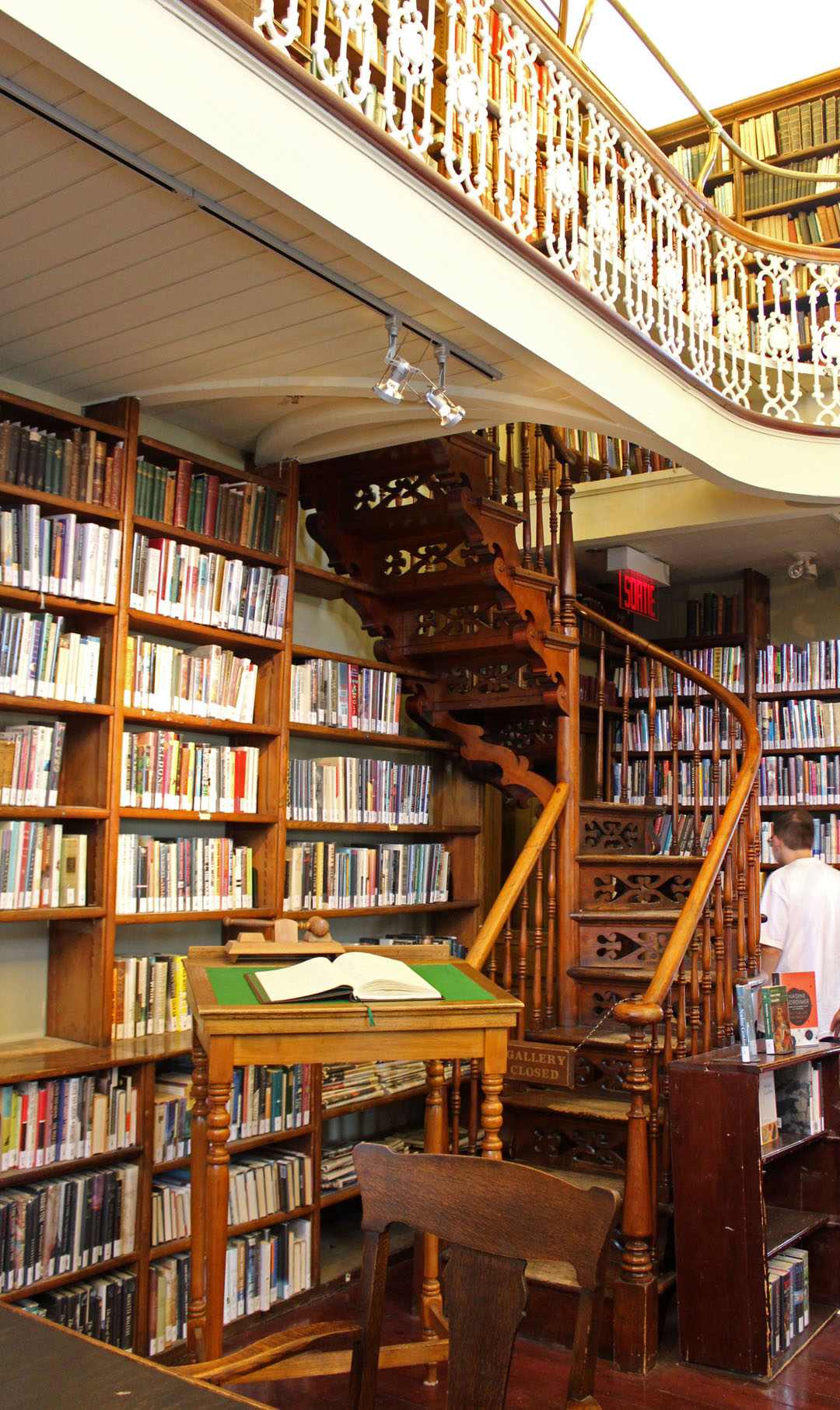
The last stop of our tour was the Library. This charming, Victorian library houses unique masterpieces dating all the way back to the 16th century.
While Morrin College didn't prove to be a success, the Morrin Centre building was also home to the Literary and Historic Society of Quebec (from 1824 to Present). It was Canada's first learned society.
They produced scholarly essays, gathered historical documents, helped to preserve Canada's heritage, and fostered the foundation of the National Archives of Canada. Over time, the Society's focus turned to the growth of its lending library, allowing public access to English-language books in a predominantly French-speaking city.
Nowadays, the Morrin Centre is home to Quebec's only English-language library, cultural centre, and historical interpretation site. Anyone is welcome to enter the library and read the books. Anyone is also welcome to join as a member of the library and borrow books for a small membership fee.
The Traveling Statue

We had some extra time at the end of our tour, so Ben told us a story about the state of Major General James Wolfe pictured above. James Wolfe successfully led the British troops on the Plains of Abraham in 1759.
This statue originally stood on a local street corner, pointing the way towards the Old Port of Quebec. The problem was...people hated the statue!
First of all, the French-speaking people despised the statue as it reminded them of their defeat by the English. Next, it was far too short to be a statue, standing only about 5 feet high. And to make matters worse, it didn't even resemble James Wolfe at all!
One day, the statue disappeared. Two sailors had stolen the statue and took it back with them onto their boat. Their ship sailed away from Quebec and ventured all over the place, including destinations like Bermuda, and back to England.
In England, the statue became part of a sign for a pub. After a few years in England, the James Wolfe statue was mailed back to the mayor of Quebec City.
Inside the packaging box were stamps from all of the ports around the world that it had visited. This original statue is now safely protected inside the comforts of this English-language library, safe from destruction and kidnapping.
Planning Your Visit

During the summer, the Morrin Centre is open daily from 10am to 4pm. You have to book a guided tour and they strongly recommend booking it online in advance to avoid disappointment.
It's possible to become a member of the Morrin Centre if you plan to visit often. Members can use the library for free, and guests can purchase day passes to the library. The library is closed on Monday and Tuesday. Please note that visiting the library is part of the tour if you'd like to see it and not necessarily study there.


Zophia says
Really interesting history that the Morrin Centre was the first jail in Quebec City, it is very well kept even after the jail is moved to somewhere else, which is nice. It’s very nice to know 2 women graduated from the Morrin College, good that many rooms and instruments used for study are still there over there well maintained.
Mary {The World Is A Book} says
This was a great way to spend a rainy day. It's such an interesting history from a prison to a school. What a great and educational tour. I love the traveling statue story! I think I would have totally freaked being in that simulated solitary confinement!
Anna says
I love visiting old prisons for some reason.'the morbid stuff hold a fascination for me. How cool that it got converted into such a pretty college afterwards! But funny that it never had more than 28 students, heh. I love that picture of the spines of antique books, btw. I love old books!!
Michele {Malaysian Meanders} says
I really like the story of the traveling statue. Nowadas, it'd be all over Instagram or Facebook. This does look like a good rainy day activity. I cannot begin to imagine a university with a total enrollment of 28 people. I wonder how many professors it had. I'm so so glad Justin let you back out of jail.
Constance - Foreign Sanctuary says
Wow! A visit to a prison and a taste of solitary confinement - that is one special way to spend a rainy day 'inside.' And Morrin Centre looks like a great escape from the rain as well - I love the architecture of the library!!
Carmen (CarmensTravelTips) says
What a great way to spend a few hours on a rainy day. Who knows what went off behind those iron walls. There's so much history and old artifacts that it makes me want to take the tour too. Thanks for sharing.
Mandie Sanders says
Oh my gosh, how much fun is that?!! I love that story about the James Wolfe statue making it's way around the world. Maybe I need to get a mascot and send it around the world. Like...the Rambling Rhinoceros. Haha
Anne Klien ( Meanne) says
Interesting read, I never been to prison visiy but that's lots of history behind the bars. Cool photos
Sammi Wanderlustin' says
Wow, how cool is that statue.... it definitely looks like something you'd find on a pub sign around here. What an awesome place to learn about history- with so much going on!
Cat says
What a fun and educational tour to learn about the history! Quebec City is such a beautiful place with lots of French influence and European architecture. I can't wait to visit there again! Thanks for sharing this at #WeekendWanderlust linkup!
Sarah Ebner says
Fabulous pictures, though I don't like the idea of solitary confinement and absolute blackness! Sounds a great visit though, and right up our street. We recently stayed overnight in an old prison!