
Here's everything you need to know about renting a car in France. While it is very easy to travel between cities and some small towns by train, having your own car provides you with more freedom.
Drive wherever you like, whenever you like. You don't need to adhere to certain schedules or endure multiple train transfers. It's also much easier to travel by car if you have luggage to transport.

Justin and I recently rented a car in France and we're going to provide you with our best tips. This is everything you need to know before you rent a car in France and some basic rules of the road that might be different by comparison to where you're from.
Jump to:
Why You Should Rent a Car in France

Simply put, renting a car gives you flexibility when you travel. There might be a little village that doesn't receive regular access by train or bus or an off the beaten path attraction.
Recently, Justin and I traveled to Lyon and Annecy, wanting to do some day trips in the area. It was impossible to reach some of these places unless we drove ourselves there.
On other occasions, the train schedules weren't convenient. While I love traveling by train when I go to Europe, it made more sense to rent a car in France this time around.
It's also possible that you could save money by renting a car. While rental cars always seem expensive, numerous high speed train tickets add up fast.
Taking tours with transportation might be convenient, but they also can get pricy. When it all comes down to it, it's quite possibly much cheaper to rent a car instead.
It might also make sense to take trains for part of your trip and rent a car for another part of it. For instance, it makes more sense to take public transportation in Paris. It also makes sense to take the train between larger cities, like Paris and Lyon.
Rent a car for the portions of your itinerary where it makes the most sense to get there by car.
Renting a Car in France: Top Tips

Before you drive in France, there are a few things to know in advance. I'll outline the basics for you here. In France, cars drive on the right hand side of the road.
If you aren't used to driving in a roundabout, you will end up navigating plenty of them in France. Yield to the oncoming drivers and drive when it is safe to do so.
Road Rules That Might Be Different
First, autoroutes are highways and usually have an "A" and a number, and routes are regular roads. The autoroutes have tolls.
The speed limits on autoroutes can vary depending on the weather. They can be up to 130km/h in good weather and go down to 110km/h in rainy weather.
In France, it is illegal to turn right on a red light. If there's a flashing amber arrow, you can proceed with caution.
Also, priority is given to the right. If there are no signs at an intersection in a smaller town, the car to the right always has the right of way.
When you approach a town and spot a sign with the town name, this indicates that the speed limit is 50 km/h unless stated otherwise. When you leave the town, there's a sign with the town's name that has a red line through it.
Toll Roads
The autoroutes are really well maintained and the fastest way to get from point A to point B. You will need to pay extra to use them.
When you use a toll road (autoroute), you can pay by cash or credit card. There is an electronic toll system (Télépéage), but you need a European bank account to register for a transponder.
Don't worry, it is easy to pay by cash or card at the booth.
One thing to make note of: there are now some automatic or unmanned toll booths called "autoroutes en flux libre" on parts of the A13/14 and A79. If you drive on an automatic toll route, you will need to pay your bill online within 72 hours or face a big fine. Enter your license plate on the Sanef website to pay your bill.
You can use websites like Via Michelin to help calculate your journey in advance, even if you'd like a rough idea on how much the tolls will cost you.
Stopping for Gas
Stopping for gas is similar to stopping for gas in other countries. You might find gas to be more expensive in France than it is at home.
Your rental car will usually be marked with the type of gas that belongs in it. They usually make this pretty clear so tourists avoid putting the wrong type inside.
Sans Plomb 95/98 (SP95/SP98) is unleaded gasoline and Gazole is diesel. The diesel pumps are usually yellow, and the gas pumps are usually black.
Most gas stations require you to pay at the pump with a credit card. Many gas stations are unmanned and won't accept cash.
The gas stations off the autoroutes will have the most expensive gas due to their convenient locations. Going into town or finding a gas station near a super market will help you save some cash.
Parking Tips
Depending on where you visit in France, there are several ways you can park your car (and pay for parking).
Urban areas usually have pay and display machines. Buy a ticket from the machine and place it on your dashboard.
Larger cities may have car parks or underground parking. You can pay by the hour or by the day.
It gets a little more confusing in small towns and city centers. Blue Zones (Zones Bleues) mean that you'll need to acquire a parking disc (disque de stationnement) from a tourism office or a local shop.
Place the parking disc on your dashboard. It will show how long you can park, which is usually for a maximum of two hours.
Do I Need an International Driving Permit (IDP)?
If your driver's license is not in a Romance language, you will definitely need an International Driving Permit (IDP).
If you are from Canada, you do not need an IDP for up to one year in France. If you spend a longer amount of time in France, you need to get a French driving license. For all tourists visiting for a short period of time, you can use your Canadian driver's license.
Technically, if your driver's license isn't in French and you get pulled over, the police may give you a difficult time if you don't have an IDP.
For Americans and those living in the UK (and other English-speaking countries), you may want to get an IDP.
In France, no one at the car rental agency checks to make sure that you have an IDP. You can book the rental car using your regular driver's license and your passport, no problem.
We are Canadian so we haven't bothered getting an International Driving Permit to drive in France. If you are Canadian and need one, visit your local CAA. If you're American, visit AAA to get one.
Driving in Countries Other Than France
It might be possible to pick up a car in one place and return it in another. This is not as common to do between countries, and it will be more expensive.
There is also the question of whether you can even drive your rental car from France into another country.
Sometimes there are limitations on this, and sometimes there are not. It's a good idea to check ahead of time if you plan to visit multiple countries in Europe.
With Discover Cars, you can view the terms of each car rental company, including whether or not you can drive it into neighboring countries.
How to Rent a Car in France

Renting a car in France isn't too different from renting a car in other nations. There are a few factors to consider when making your advance booking.
And yes, you will want to book your rental car in advance. There's no guarantee that a car will be available on the spot. Plus, it will be more expensive and might not be the car you want (ie. a massive SUV vs a small car, manual transmission, no trunk space, etc.).
Automatic vs. Manual Transmission
Automatic or manual transmission? It is usually cheaper to choose a car with manual transmission as they are more plentiful in Europe.
With that said, you shouldn't have any issues finding a car with automatic transmission. Justin and I both can't drive manual transmission cars, so we always choose automatic when we travel.
When booking with Discover Cars, just check a box to filter out the automatic or manual transmission cars.
Unlimited Mileage vs. Limited Mileage
When booking a rental car, there are usually two options: unlimited mileage or limited mileage. If you plan your trip ahead of time, you should be able to tell approximately how many miles you'll be driving each day.
In many countries, car rental agencies provide unlimited mileage. We did find that in France, quite a few of the car rental companies put limitations on the mileage (around 100 miles per day).
Generally, France isn't a huge country and we never went above 100 miles a day. So, we didn't mind choosing the limited mileage and saving some money.
You can combine the mileage across days. You might end up driving 20 miles one day and 120 miles the next day. For example, if you're renting a car for 5 days, just make sure you don't use more than 500 miles across your trip.
Do I Need Car Insurance?
When you rent a car in France, you will need car insurance. Thankfully, the process of obtaining car instance is very easy.
First, your travel credit card may already include car insurance. Make sure you have this feature before you travel. Also, make sure you use this credit card when you make the car rental booking.
Next, you can obtain travel insurance right away when booking your rental car with Discover Cars. You'll see the cost of adding the car insurance in advance and you'll be able to purchase it on the spot.
Otherwise, you can purchase car insurance from the car rental company. This is usually the most expensive option. If your credit card doesn't include car insurance, I suggest adding it through your Discover Cars booking.
Not only is car insurance necessary when renting a car in France, it provides you with peace of mind. If anything should happen to the car while you're driving around, you'll be covered.
A Sample Road Trip in France
If you're traveling to France and you plan to say in one or two cities the entire time (for instance, Paris and Lyon), you may not need to rent a car. High speed trains and public transportation are a great way to reach and get around these cities.
When it comes to getting outside of these cities, renting a car in France makes sense. It can be quicker to drive from place to place.
Plus, some smaller villages or attractions are not as accessible by train. Even if they are accessible, it might not be worth spending your entire day and multiple transfers to get there.
Here's a sample road trip of France, roundtrip from Lyon. First, start by flying into the Lyon Airport (Aéroport de Lyon-Saint-Exupéry) and pick up your rental car in Lyon.
Palais Idéal and Tain L'Hermitage

Palais Idéal is a worthwhile stop on any road trip of France, especially if you're visiting Auvergne-Rhône-Alpes and Burgundy. This castle was built over 34 years by a French postman who incorporated designs and whimsy from around the world.
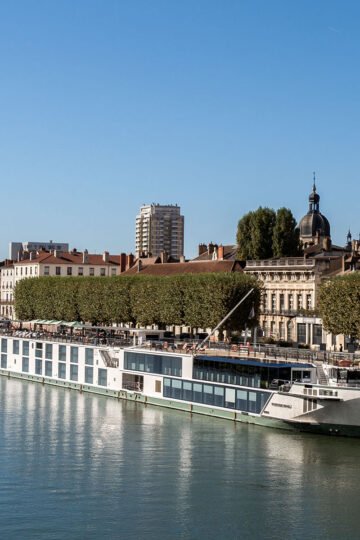
Tain L'Hermitage is a popular stop on river cruises of the Rhône River. Otherwise, I wouldn't think it to be overly touristy. This quaint town is divided in two with small developments on either side of the river.
Check out Tain L'Hermitage and then walk across the bridge to see Tournon-sur-Rhône.

This town is known for its wine and its chocolate as the site of the longstanding Valrhona chocolate factory. Even if you don't take a tour of Valrhona, stop by the shop for some treats and samples.
Spend the night at a charming hotel in Tain L'Hermitage.
Annecy and Gorges du Fier

Next, it's time to drive to Annecy. On the way, stop at Gorges du Fier, a spectacular trail that meanders through massive boulders and an impressive gorge.
You can also continue your road trip around Lake Annecy, stopping in Talloires, Duingt, and the Col de la Forclaz, a mountain pass in the Alps with incredible views.

Annecy, surrounded by mountains, is said to be one of the most beautiful cities in France. There are great restaurants, cafes, and shops to discover. Wander around town early in the morning to visit the farmer's market in the streets.
I suggest spending two nights in Annecy for the full experience, though you could combine Gorges du Fier and Annecy into one day if you must. Stay at a hotel in Annecy.
Dijon

Dijon is a charming little town in the wine region of Burgundy. The city center is a UNESCO World Heritage Site with many restaurants, attractions, and idyllic pedestrian streets.
Naturally, Dijon is famous for Dijon mustard and you can do mustard tastings at historic mustard shops.
Dijon also has historic self-guided walking tours, beautiful parks, and amazing lookout spots. I suggest spending one full day in Dijon, spending the night at a comfortable and centrally located Dijon hotel.
Beaune

Beaune is the capital of Burgundy's wine country. The town itself is lovely to explore. Some notable stops include the 15th century Hôtel-Dieu Hospice.
I also suggest going for a wine tasting at Maison Champy, one of the oldest winemakers in Burgundy.
Aside from spending time in Beaune, we loved taking a bike tour in the countryside. From Beaune, ride through quaint villages and participate in wine tasting. Here's a half day bike tour and a full day bike tour.
Stay at a local hotel in Beaune.
Pérouges and Lyon

Finally, head back to Lyon and spend a couple of days in the city. On the way, stop in the preserved medieval village of Pérouges for a couple of hours. It truly feels like stepping back in time.
Whether you keep the car while you're in Lyon or you drop it off at the airport before heading in the city is up to you.
Sometimes the rental car won't cost too much more to keep it for a couple of extra days. That will make it easier to get to your hotel and back to the airport.
Sometimes it will be more costly to keep a rental car you may not be using. There might be the additional costs of hotel parking and extra days to keep the car that won't be worth it.

When you're in Lyon, there's a good chance that you'll be walking everywhere. When we spend a couple of days in Lyon, we used some public transportation and mostly ventured around by foot.
There is a train that runs between the Lyon Airport and the city center. Uber is another great option. If you decide to ditch the rental car, you could always check into your hotel first (and drop your luggage), take the car back to the airport, and then take the train back to the city center (luggage free).
Find the Best Rates on Car Rentals
When we travel, we always use Discover Cars to find the best prices on car rentals. With Discover Cars, you can compare multiple car rental agencies to find the best fit for your adventure.
They also have excellent customer service, too! We always find our car rentals to be easy and seamless with the best rates.
So, have we convinced you to take a road trip around France yet? No matter where you decide to go, it's such a beautiful country and I know you'll fall in love with it.
If you're going to be visiting France, take a look at our France travel guide to find tons of helpful advice and itineraries.
Want more travel tips and inspiration? Follow me on Instagram! I share daily adventures, whether I'm at home in Ontario, Canada, or halfway across the world!
Don't forget travel insurance!
Heading out of the country? Don't forget to get travel insurance. It's best to be covered in case of an emergency, cancellation or accident.
More Car Rental Guides
Thinking about renting a car in other destinations around the world? Here's our advice for car rentals in places we've visited:



Leave a Reply